Orchard House
Residential
RO
EN
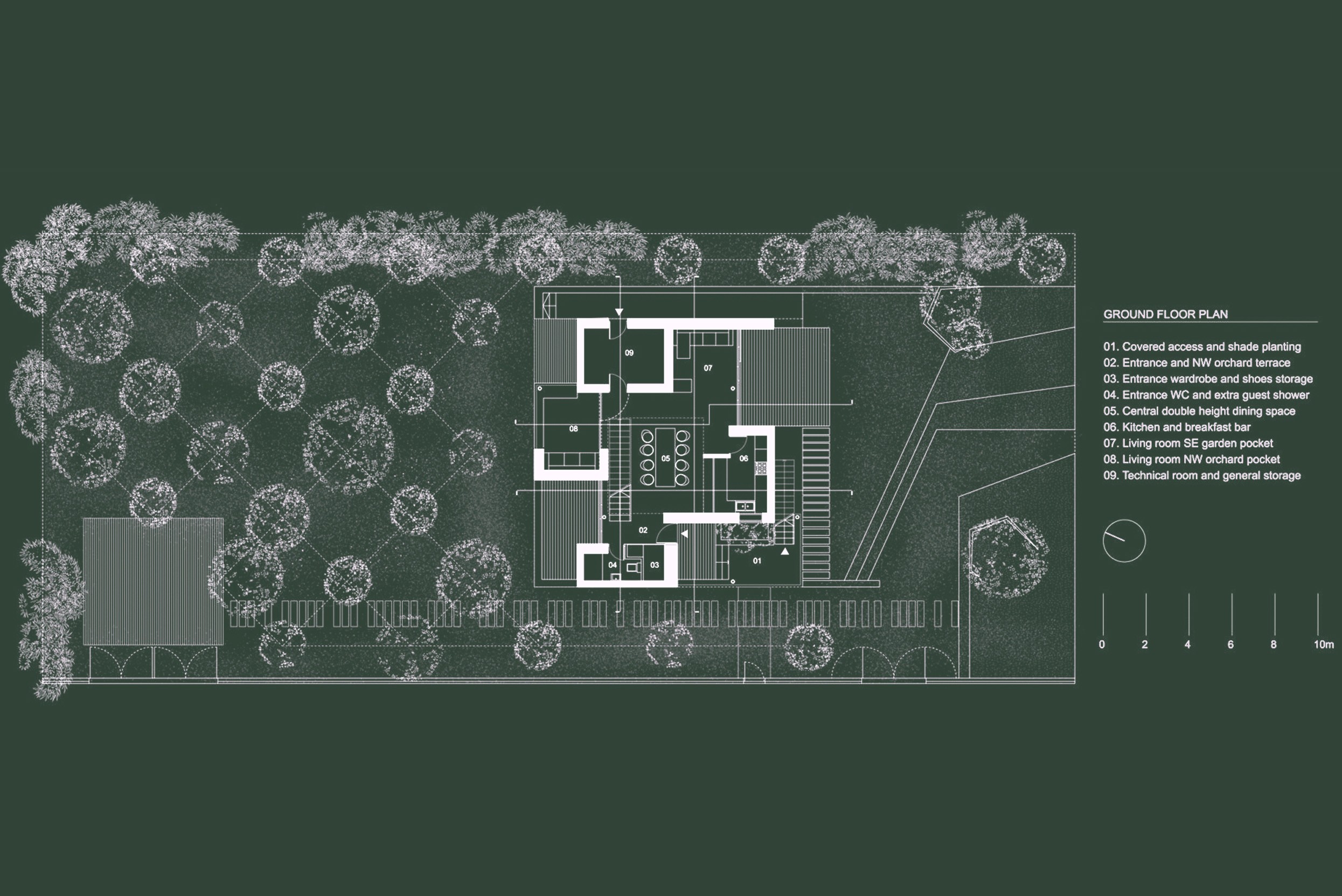
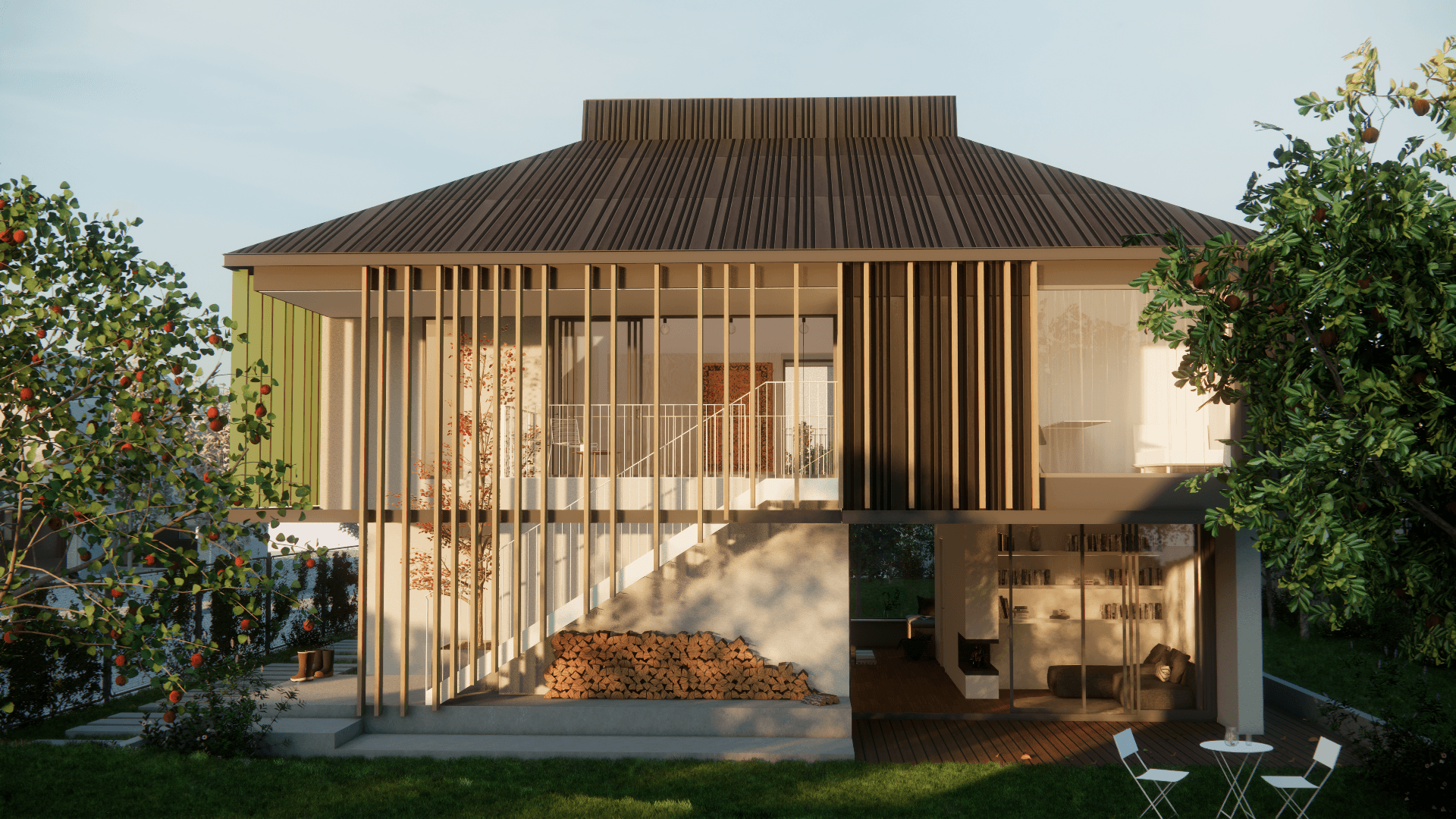
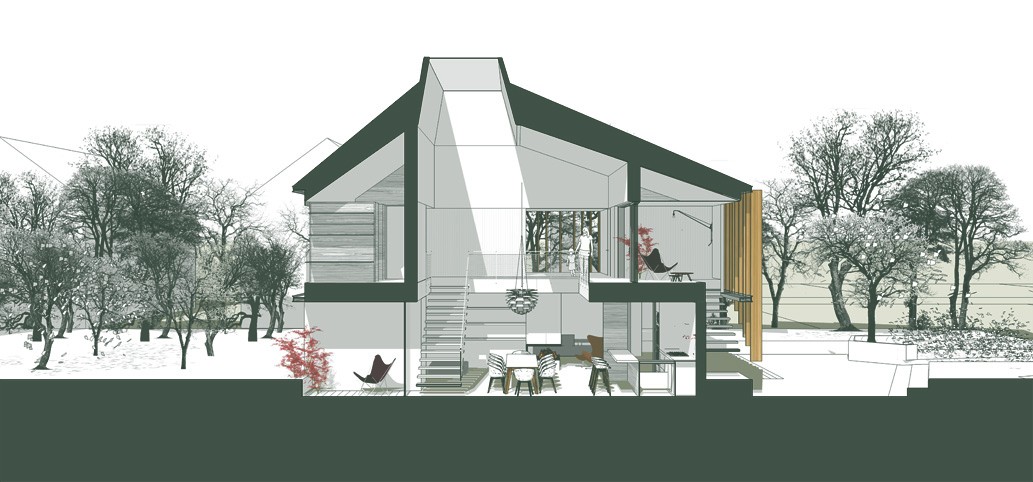
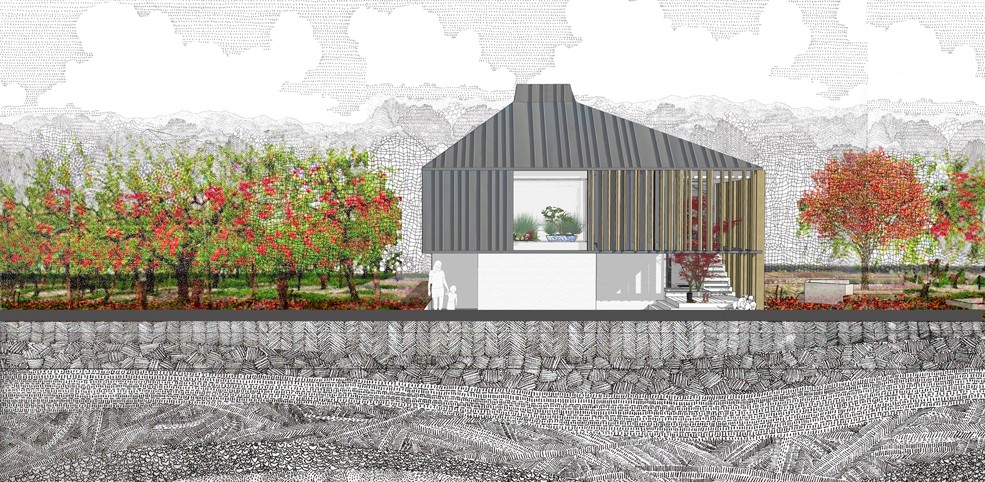
After almost a century of collective living, the need to remember the period when the city was mainly defined by courtyards and estates is felt in Bucharest. People used to live in a courtyard with a house in a world where outdoor activities predominated, a world in which the inside revolved around the outside space. Thus, the proposal represents a modern approach to the house with an orchard. The floor plan, although it may seem at first glance to tend towards introversion (due to the central positioning of the skylight), is actually defined by fluidity. This was achieved through the interweaving of interior-exterior and primarily by creating flexible pathways to connect the interior spaces either directly with the exterior space of the courtyard or with a private terrace. Another element that dominates the interior atmosphere of the house is surprise; as you go through the house, you discover spaces and visual connections with the garden that you would not have anticipated initially. However, the visual connections are not only focused on the garden but also concentrate on the skylight surrounded by stairs and fluid circulation. This type of configuration provides intimacy for the house's residents without forgetting to bring them together and encourage interaction. Designed with a simple overall image and taking into account the context in which it was integrated, the house is outlined as being composed of a ground - mineral socle and a wooden upper floor. Inside, wood envelops the wall surfaces and gives warmth to the space.
Program
Residential
Location
Bragadiru, Ilfov
Surface
300
m2
Year
2016
Status
Completed
Team
Anca Mihalache, Alexandru Popescu
RO
After almost a century of collective living, the need to remember the period when the city was mainly defined by courtyards and estates is felt in Bucharest. People used to live in a courtyard with a house in a world where outdoor activities predominated, a world in which the inside revolved around the outside space. Thus, the proposal represents a modern approach to the house with an orchard. The floor plan, although it may seem at first glance to tend towards introversion (due to the central positioning of the skylight), is actually defined by fluidity. This was achieved through the interweaving of interior-exterior and primarily by creating flexible pathways to connect the interior spaces either directly with the exterior space of the courtyard or with a private terrace. Another element that dominates the interior atmosphere of the house is surprise; as you go through the house, you discover spaces and visual connections with the garden that you would not have anticipated initially. However, the visual connections are not only focused on the garden but also concentrate on the skylight surrounded by stairs and fluid circulation. This type of configuration provides intimacy for the house's residents without forgetting to bring them together and encourage interaction. Designed with a simple overall image and taking into account the context in which it was integrated, the house is outlined as being composed of a ground - mineral socle and a wooden upper floor. Inside, wood envelops the wall surfaces and gives warmth to the space.
EN
Following nearly a century dominated by collective housing typologies in Bucharest, there arises a collective yearning for an era when the city’s domestic identity was defined by generous courtyards, orchards, and private estates—a historic condition where dwelling unfolded within a courtyard with a house, where outdoor rituals took precedence, and where domesticity gravitated organically around exterior space. In response, this project puts forward a contemporary reinterpretation of the orchard-homestead archetype. The planimetric layout—while appearing introspective at first glance due to the prominence of a central skylight—is animated by profound spatial permeability. Fluidity is achieved through the active interweaving of interior and exterior domains, tracing flexible circulation paths that tie internal living spaces directly to the open orchard or to secluded, private terraces. Spatial surprise anchors the home's atmospheric narrative: traversing the plan reveals unexpected pockets and calibrated sightlines toward the landscape that remain hidden from initial viewpoints. Rather than directing views solely outward, the architecture frames visual axes inward toward a central lightwell, wrapped by the primary staircase and an open gallery corridor. This spatial configuration safeguards personal retreat while intuitively drawing inhabitants together around a shared core. Conceived with elemental restraint and deep contextual sensitivity, the building volume articulates a dual materiality: a grounded mineral plinth at the ground floor crowned by an elevated timber volume reminiscent of traditional attic forms. Inside, natural timber paneling wraps the interior surfaces, enveloping the home in tactile warmth and quiet tectonic honesty.



Index
Project
Program
Featured
Year
Index
Project
Program
Featured
Year
Index
Project
Program
Featured
Year
Index
Project
Program
© 2026
Ioan Vodă Caragea 24B
Sector 1—București
info@arhitectiasociati.ro
© 2026
Ioan Vodă Caragea 24B
Sector 1—București
info@arhitectiasociati.ro
© 2026
Ioan Vodă Caragea 24B
Sector 1—București
info@arhitectiasociati.ro
Ioan Vodă Caragea 24B
Sector 1—București
info@arhitectiasociati.ro